
Actuarial triangles are useful summaries, but annual cells discard timing within each year and make estimates depend on where the period boundaries fall. Finer cells recover some detail but leave less data in each cell. Continuous approaches can retain that timing and share information between nearby observations. When smooth curves fit adequately, the annual boxes may be an unnecessary layer. In my repeated-sample benchmark, though, classical chain ladder performed better overall, so the case for continuous fitting rests on the timing information it keeps, not on accuracy.
Martínez-Miranda, Nielsen, Sperlich & Verrall (2013) describe classical chain ladder as a “structured histogram.” Their continuous approach replaces the histogram with smoothing while keeping the core assumption:
Expected activity = origin pattern × development pattern
The observation boundary stays triangular: we only see events whose origin time plus delay falls before valuation. A continuous fit must account for that boundary. The empty future region contains missing observations, not observed zeros.
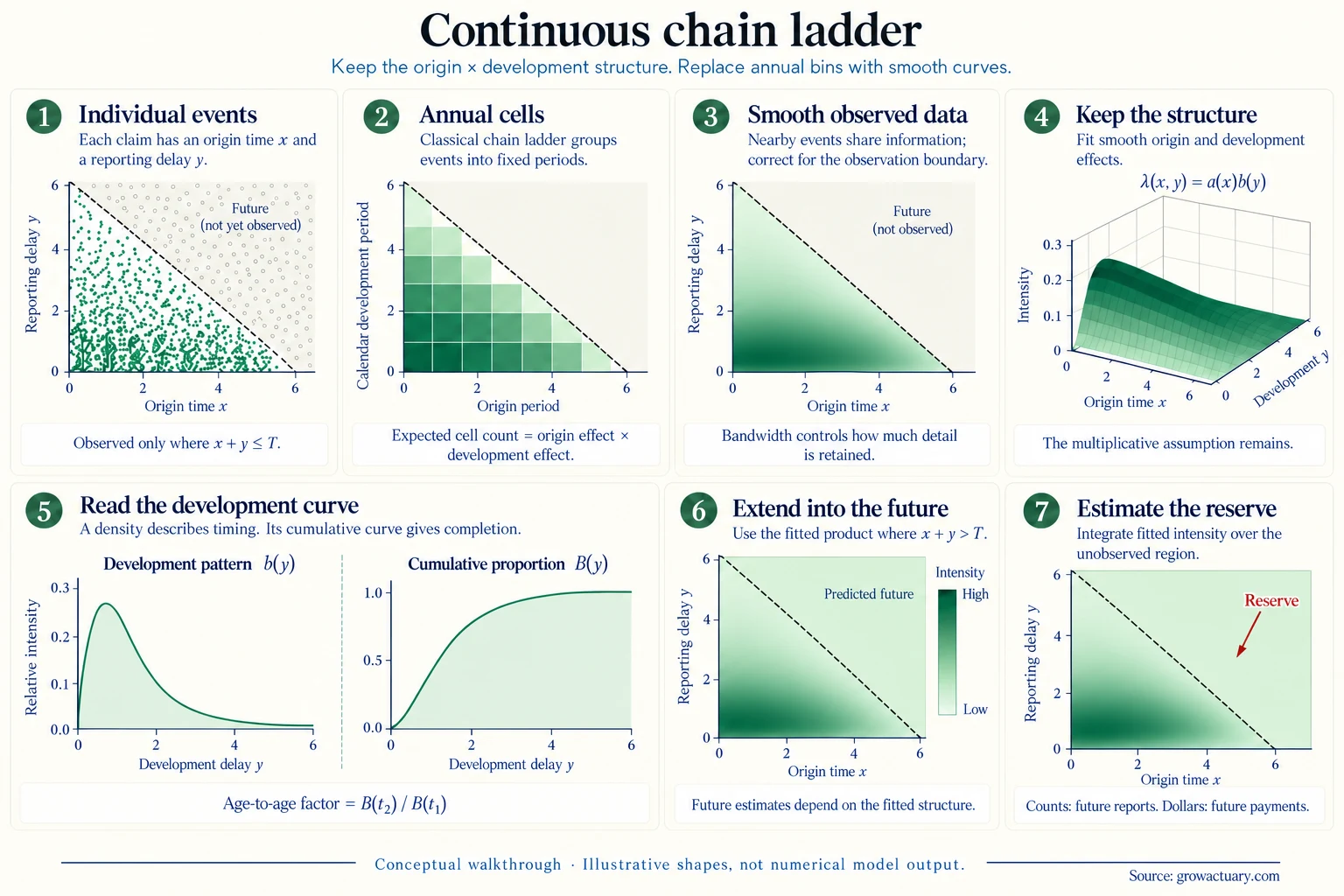
The tool below solves the same simulated reserving problem both ways. Classical chain ladder develops an annual triangle. The continuous fit estimates smooth origin and development curves, then integrates their product over the unobserved region. At the starting settings, classical estimates 523 unreported claims and $10.70m unpaid; continuous estimates 508 and $11.00m.
Compare Triangle and Intensity, then open Reserves and reveal the future to check the estimates. Adjust assumptions changes timing and smoothing. Counts track unreported claims; dollars also include reported claims awaiting payment.
The lab uses a smoothing adaptation, rather than reproducing the paper’s estimator; payments are an educational extension.